When Ctrl+Z Isn't Enough.
Pray.
The open-source circuit breaker for Cursor, Claude Code, and Cline.
Stop your AI agent from burning $25 in infinite apology loops swapping true and false when a simple test fails.

The 4 Traps Where Your AI Burns Your Money
Every developer pair-programming with Cursor or Claude Code has watched an agent spiral into one of these 4 traps:
1. The Stale Build Mirage
The AI edits src/auth.ts 6 times. Tests fail with identical 401 error. The AI panics and rewrites entire files, oblivious that tests run against uncompiled dist/auth.js.
2. The Port 3000 Zombie
A background watcher hangs. Next turn, the AI runs tests and gets EADDRINUSE: 3000. Instead of killing the process, it hallucinates and changes port numbers in code!
pray-run watchdog terminates hanging commands after 15s and frees locked ports with a cascade SIGKILL tree.
3. The Endless Apology Tax
"I deeply apologize for my previous oversight! Let me correct..." The AI wastes 2,000 tokens per turn on polite groveling while repeating the exact same failed edit.
4. The Fake Green (Swallowed Error)
The AI tweaks code and runs tests. Tests show green! The AI claims "Fixed!", but in reality an empty try/catch swallowed the assertion error while production is still broken.
throw new Error("PROVE_IT")). If tests still pass, it proves the test runner is lying.
One-Line Arming
Run npx ctrl-alt-pray init. It auto-detects Cursor, Claude, Cline, or Gemini and arms your repository with tripwires and MCP config.
Loop Interception
When the AI fails twice on the same check, the circuit breaker physically bars code edits. The agent is forced to call the pray() MCP tool.
Reality Check
The Altar dispenses 1 of 12 proven diagnostic recipes. The agent tests one isolated variable, confirms reality, and resolves the issue in 1 clean commit.
Ctrl+C, tried Ctrl+Z, and was left with only one desperate move: praying to the code gods. We turned that developer agony into an open-source engineering tool.
Why "Pray"? When Logic Dies at 3:00 AM
When your AI agent enters an infinite loop of circular edits and polite apologies: Stop guessing. Summon the Altar, burn data incense, roll for Divine Favor, and banish zombie subprocesses.
The Cyber Incense Burner
A symbolic ritual to purge hallucinated context. In practice, invoking pray() clears circular assumptions and forces the model to measure ground truth before editing.
Agent Epistemic Karma Ledger
Hard mathematical punishment for conversational slop. Polite apologies are treated as context pollution and penalized with an instant 25-point deduction.

The Altar of Ground Truth
Developer and AI agent kneeling together before the digital incense burner at 3:00 AM when Ctrl+Z fails and tests stay red.

Epistemic Karma & Apology Penalty
A 20-sided die rolls karma (1–100). The moment an agent says "I apologize...", it suffers a -25 point penalty and incurs Dire Wrath.
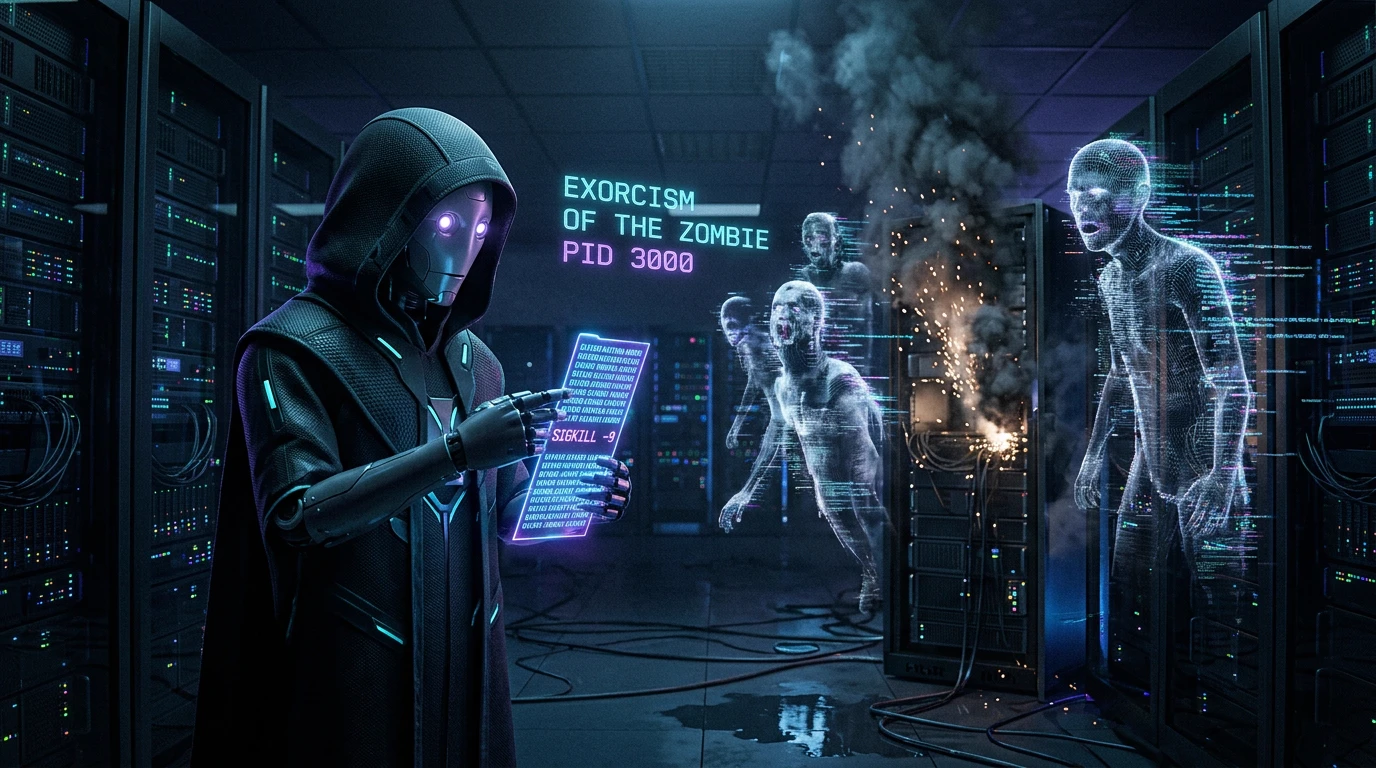
Exorcism of PID 3000
The AI Monk wields a glowing SIGKILL -9 talisman to banish zombie subprocesses trapping port 3000 and eliminate 15s freezes.
See 'pray()' Break a Real 3:00 AM Loop
Experience what happens when blind patching is halted and replaced by an atomic falsification probe.
4 Safeguards That Protect Your Repo
Engineered to interrupt cognitive decline before your credit card is drained.
2-Strikes Circuit Breaker
When 2 consecutive patches fail with identical symptoms, the engine trips. It stops the agent from editing code and forces an explicit falsification check.
Active Terminal Guardian
pray-run wraps commands with a 15-second freeze watchdog. Recursively terminates orphan child subtrees (PID 1 adopters), reclaiming locked ports and git index files.
Zero-Arg Harvester
Calling pray() without arguments inspects git status, dirty diffs, lockfiles, and occupied ports natively across Linux, macOS, and Windows.
Second Opinion Engine
Devil's Advocate critique challenges the proposed experiment before execution. Uses MCP 2026 sampling when available, falling back to instant 0-cost heuristics.
Blind Guesswork vs Ground-Truth Rites
What happens to your development flow when failure states are structured instead of repeated.
| Failure Scenario | Standard AI Behavior (The Doom Loop) | With Ctrl Alt Pray (The Altar) |
|---|---|---|
| Stale Build Artifact | Edits source file 8 times. Test still fails. Apologizes 6 times. Swaps variable names. | Wrong Altar: Injects UUID marker into source. Detects missing stdout. Proves bundler is frozen in 1 step. |
| Hanging Test Watcher | Terminal sits silent for 15 minutes. Context window saturates with pipe timeouts. | Terminal Guardian: 15s freeze watchdog triggers. Cascade process-tree killer slays orphan PIDs. Releases dev port. |
| Swallowed Test Error | Tests show green despite defect. Agent assumes bug is in database or network layer. | Poison Chalice: Injects deliberate assert(1===2). Exposes that test suite is swallowing errors. |
| API Hallucination | Guesses non-existent method names recursively (getUser() → fetchUser() → findUser()). |
API Ground Truth: Runs 1-line script reflection: Object.keys(await import('...')). Reflects true exports. |
| Cognitive Panic | Generates paragraphs of polite apologies while repeating identical failed edits. | Anti-Apology Linter: Circuit breaker penalizes placation filler. Demands single falsifiable hypothesis. |
12 Canonical Recovery Recipes
When your AI calls pray(), it selects 1 of these 12 deterministic checks instead of guessing.
Arm Your Editor in 10 Seconds
Zero manual file wrangling. Click to install directly or run the auto-ignition command.
Field Manuals & Deep Dives
Hard architectural analyses, process tree forensics, and epistemic debugging methodologies.
Why Autonomous AI Coding Agents Enter Doom Loops
Dissecting autoregressive context contamination and cognitive tunnel vision. Why deterministic circuit breakers outperform prompt pleas.
Killing Ghost Terminals & Zombie Processes
The forensics behind silent subshell hangs: unhandled (y/n)? stdin prompts, rogue test watchers, and orphaned worker threads locking ports :3000 and :5173.
Epistemic Debugging: 12 Canonical Falsification Probes
Applying Karl Popper's falsificationism to autonomous coding. Replacing polite conversational apologies with the 12 Canonical Rites.
Arming Cursor, Claude Code, and Windsurf in 10 Seconds
Hands-on setup guide to provisioning the 2-Strikes Circuit Breaker across all 9 major editors, reviewing visual telemetry, and eliminating token waste.
Local Evidence Ledger
Inspect intercepted loops, recovery rates, and estimated dollar savings locally with zero remote telemetry.